The Problem with Mooring Security
Break-ins on swinging moorings share a frustrating pattern: the owner discovers the incident hours, days, or sometimes weeks after it happened. By then there is no precise time of incident, no witnesses, no tracking of the approach vessel, and no coordinated response. Even when a crime is reported, prosecution is extremely difficult without timestamped evidence.
Channels like the Wych in Poole Harbour are effectively blind spots for harbour CCTV. The boats are out of sight, out of Wi-Fi range, and often unvisited for days at a time. A traditional alarm system — or a home security camera — simply cannot work in this environment.
The key insight is this: the owner needs to know exactly when something happens, not discover it later. That changes everything about what the camera needs to do.
Why a Home Security Camera Won't Work
The vast majority of security cameras on the market — including well-known brands like Ring, Arlo, and Nest — are designed for a home environment. They assume two things that a mooring cannot provide:
Permanent Wi-Fi
Marina Wi-Fi rarely reaches swinging moorings, and even pontoon Wi-Fi is unreliable. Without connectivity, the camera cannot send any alert.
Mains Power
Boats on moorings have no shore power. A camera running on the boat's 12V battery will drain it within days, leaving the boat without engine-starting power.
Beyond connectivity and power, home cameras also typically require a paid cloud subscription for motion-triggered alerts, lack the IP weatherproofing rating needed for a marine environment, and do not support the external notification integrations needed to connect to a community platform like MoorMesh.
What a Marine Security Camera Must Have
Based on real-world deployment on Poole Harbour moorings, here are the non-negotiable requirements for a camera that will actually work — and the reasoning behind each one.
| Requirement | Reolink Go Plus | Typical Home Cam |
|---|---|---|
| 4G LTE connectivity | ||
| Solar or 12V powered | ||
| No mandatory cloud subscription | ||
| External webhook / email notifications | ||
| IP66 or better weatherproofing | ||
| Loud onboard siren | ||
| Person / vehicle detection (AI) | ||
| Night vision / colour night vision |
Our Recommendation: Reolink Go Plus
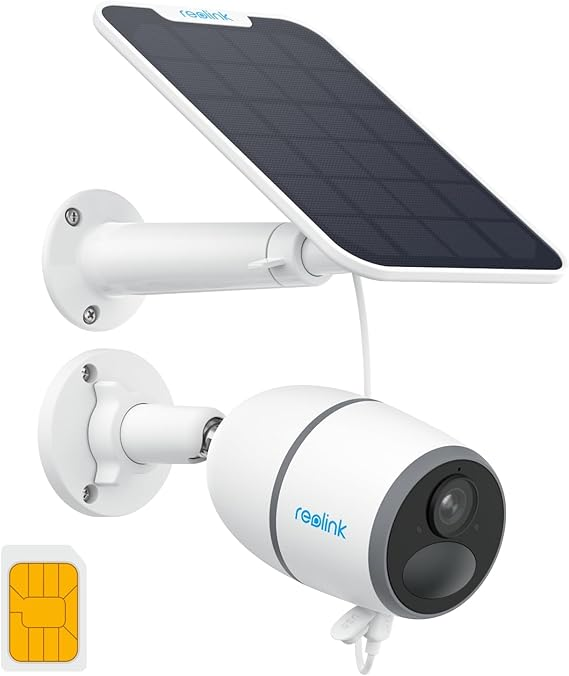
After evaluating the available options, MoorMesh recommends the Reolink Go Plus with Solar Panel. At approximately £100–£150, it is the most capable camera in its price bracket for a marine environment, and it is the only camera we currently support for MoorMesh integration.
The camera runs entirely on its integrated solar panel and a built-in rechargeable battery, meaning it requires no shore power and no connection to the boat's 12V system. Its 4G LTE modem provides connectivity anywhere there is a mobile signal — including the Wych channel and other areas beyond marina Wi-Fi reach.
Critically, the Reolink Go Plus supports external email and HTTP notifications when motion is detected. This is the integration point that MoorMesh uses: when the camera triggers, it sends an alert to the MoorMesh platform, which then notifies the entire mooring community via Telegram and logs the incident with a timestamp and map location.
Unlike many competitors, Reolink does not require a paid cloud subscription for motion alerts. The camera works with the free Reolink app, and all alert functionality is available without any ongoing fees beyond a 4G SIM plan — which starts at around £4.99/month for 1 GB (more than sufficient for motion clips).
4G LTE
No marina Wi-Fi needed
Solar Powered
No shore power needed
IP66 Weatherproof
Built for the British weather
Instant Alerts
Push notification to your phone
2K / 4MP Resolution
Sharp enough for evidence
MoorMesh Integration
Email alert hook built in
Complementary Layer: AirTag-Style Trackers
A camera detects and records an intrusion. A tracker helps recover stolen property afterwards. The two layers complement each other — and for high-value items like chartplotters, VHF radios, outboard engines, and dinghy equipment, a discreet tracker is a low-cost insurance policy.
The approach recommended by MoorMesh (and endorsed by Dorset Police at their marine marking events) is to epoxy a small tracker directly onto the equipment — hidden from view, but able to report its location via Apple's Find My network. With millions of iPhones worldwide acting as silent relays, even a stolen item that has left the harbour can often be located in near real-time.
ATUVOS trackers are a cost-effective alternative to Apple AirTags that use the same Find My network. At IP67 waterproof rating and with up to a year of battery life on a standard CR2032 cell, they are well suited to the marine environment.
Important limitation
AirTag-style trackers require an iPhone nearby to relay their location. In remote anchorages or if the thief uses an Android phone, the tracker may not update immediately. They are a useful additional layer — not a replacement for a camera or security marking.
The Community Layer: Why One Camera Isn't Enough
Even with the best camera installed, there is a fundamental limitation: the owner may not be nearby, may not have mobile connectivity at that moment, or may not be able to act quickly enough. A camera alert to a single person is far less powerful than an alert to an entire community.
This is the problem MoorMesh was built to solve. When one enrolled camera triggers, the entire mooring community is notified instantly via Telegram. A timestamped incident log is created automatically. The mooring location is shown on a shared map. Harbour patrol vessels, CCTV operators, and the Harbour Commission can be directed to the exact location within seconds — while the suspect vessel is still in the harbour.
Importantly, MoorMesh has no access to your live video or recordings. The platform receives only the motion trigger signal — the same signal your phone receives — and uses it to coordinate the community response. Your footage remains entirely private.
* As an Amazon Associate, MoorMesh earns from qualifying purchases. Product prices and availability are accurate at the time of publication and are subject to change. Purchasing through these links supports the MoorMesh platform at no additional cost to you.